Buying guide
Understand Pricing, Terms, and Rollout without a Procurement Maze
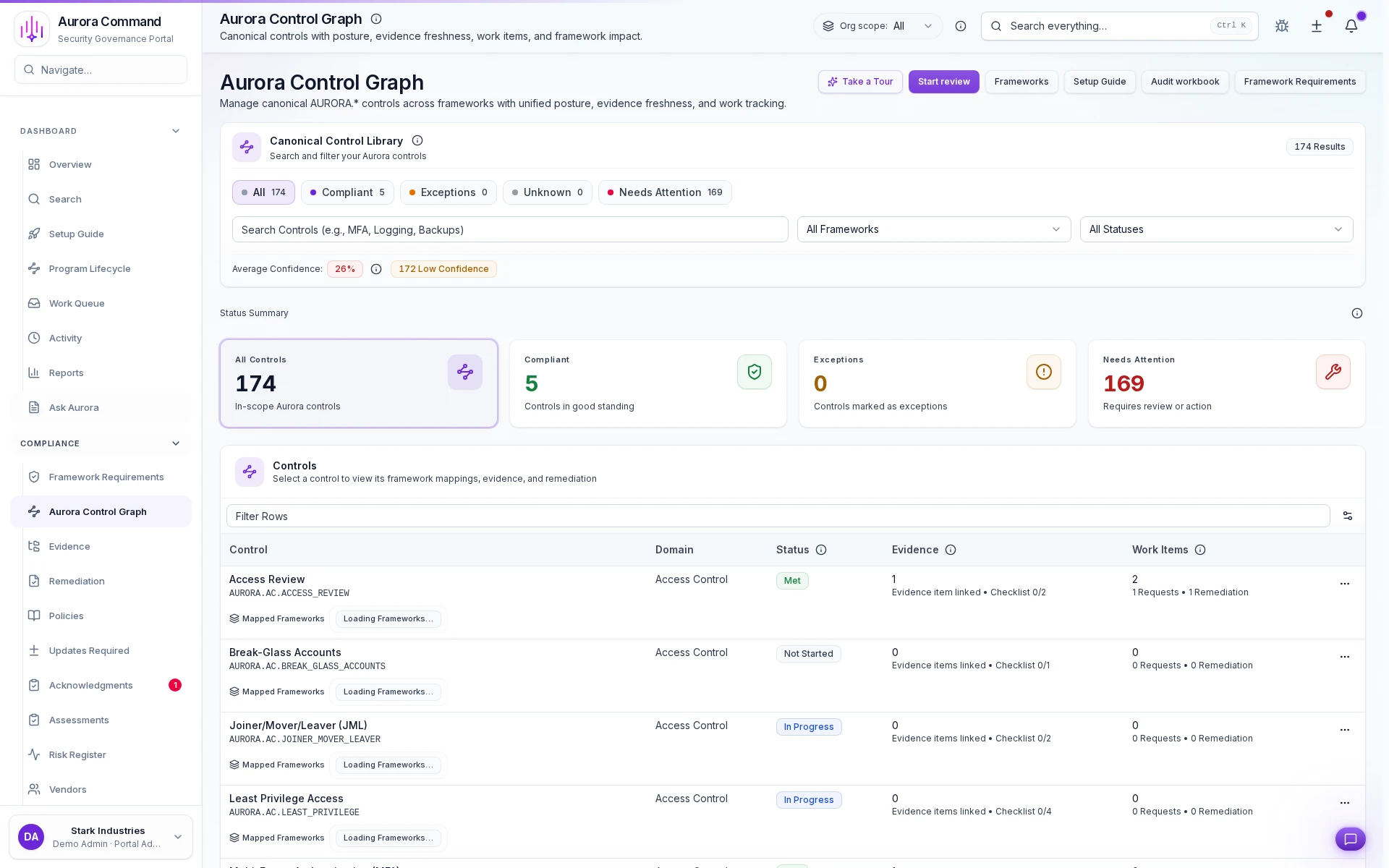
Procurement-safe proof posture
Map one library across every framework
Surface controls that still need attention
Hold a low-confidence mapping until a human signs off
Tie each control to evidence and remediation work
Procurement-Safe Proof Posture
enterprise-control summary audit-period export posture procurement-ready output map
Align Channel, Controls, Commercial Terms, and Support Expectations Early
01
Choose the Commercial Path
Self-serve, sales-assist, or quote-only based on footprint, Command scope, and procurement constraints.
02
Review Included Controls
Aurora names the enterprise controls mature procurement teams expect in the base product.
03
Pick the Transaction Path
Direct annual invoice or private offer. The product packaging stays the same regardless of channel.
04
Separate Command Deployment Terms
When Command is in scope, deployment, premium support, and boundary terms stay explicit instead of hidden in a blended quote.
05
Clear Renewal and Add-On Terms
Renewals, true-ups, and add-on pricing stay simple enough to approve without guesswork.
Why Procurement Slows Down Even When the Product Fit Is Real
Expansion Rules Are Vague
Aurora publishes common units and thresholds so procurement knows how growth changes the deal.
Enterprise Controls Show Up Late
Aurora names the control surface buyers expect instead of relying on generic enterprise-grade language.
Command Gets Blended into the Wrong Motion
Aurora keeps regulated and hybrid Command on a separate commercial path so procurement understands the different terms.
The Commercial Artifacts Procurement Teams Use
The Pages That Usually Shorten Internal Review
01Pricing
The public module catalog, plan anchors, and inclusion promises.
02How pricing works
The thresholds, add-on units, true-ups, renewals, and channel mechanics in plain language.
03Enterprise Controls
The named identity, auditability, and export controls Aurora includes in the paid product story.
04Regulated and hybrid Command
The Command path for teams whose technical proof needs to stay inside the environment boundary.
The Commercial Topics Aurora Brings Forward Early
Renewals and Commercial TermsAurora explains annual renewal terms, add-on unit behavior, and commercial path options before finance asks twice.Reviewer-Safe OutputsEnterprise controls, reviewer operations, and export posture sit together so procurement sees the buying workflow clearly.Private Offer or Direct InvoiceAurora routes the same product scope through the channel procurement prefers without changing the product logic.
Plain-Language Answers for the Commercial Review Team
Does Aurora publish real pricing or just anchor copy?
Does Aurora publish real pricing or just anchor copy?
Aurora publishes list pricing for Platform Core, major non-Command modules, and common expansion units. Procurement sees the commercial shape before a private quote exists.
Are enterprise controls included or hidden?
Are enterprise controls included or hidden?
Aurora includes named enterprise controls in the paid plan. The goal is to remove late-stage procurement friction, not create another surprise upsell.
Why is Command handled separately?
Why is Command handled separately?
Command changes the deployment, support, and environment-boundary burden. Aurora keeps that motion separate so the standard software path stays clean and the Command path stays honest.
Can Aurora work through our preferred channel?
Can Aurora work through our preferred channel?
Yes. Aurora supports direct annual invoice or private-offer procurement while preserving the same core pricing logic. The tenant billing state stays authoritative inside the product; accounting systems remain reconciliation targets. (AWS Marketplace listing is on the roadmap.)
Which path is self-serve, and which needs a walkthrough?
Which path is self-serve, and which needs a walkthrough?
Core and Professional plans, plus most add-ons, are self-serve inside published thresholds: up to 10 operators, 3 workspaces, 25 automated connectors, 250 vendors, 1,000 covered users, and 5 frameworks. Enterprise, Command, and any in-perimeter deployment are not self-serve - Command requires a mandatory scoping conversation and deployment package. The self-service plan is also business-use only; it isn't offered for personal, family, household, or public-sector use unless Borealis agrees otherwise in writing.
What are the renewal, cancellation, and refund terms?
What are the renewal, cancellation, and refund terms?
Subscriptions bill annually in advance and renew automatically until canceled; canceling stops future renewals only and does not refund the term already in progress. Fees are non-refundable once charged for a paid term, and a one-time setup or implementation fee becomes non-refundable once Aurora begins that work. For annual business plans, Aurora's default practice is at least 30 days' notice before a pricing or package change takes effect on a future renewal. Full terms: the Self-Service Subscription Terms.
How long does implementation take?
How long does implementation take?
Aurora does not publish fixed implementation timelines. Self-serve configurations have no required fee and go live on your own schedule; guided rollout support is optional and published (starting at $1,500 one-time). Enterprise effort is scoped on a call before purchase. Command requires a mandatory deployment package ($10,000–25,000 one-time) plus a premium support minimum ($6,000 / yr).
Bring Your Commercial and Procurement Questions to One Call.
Share finance, procurement, or legal concerns alongside product fit questions. We walk through the cleanest buying path without hiding the harder parts of the deal.
Share a framework, buyer request, questionnaire, or renewal packet. We'll show how Aurora handles it.
Assurance Documentation for Procurement
Share the named subprocessor register, the data-handling matrix, the security one-pager, and the dated assurance roadmap directly with legal and security review, alongside the Data Processing Addendum.