Product Module
Prove Your Notification Chains Work Before the Real Emergency Tests Them.
Run communication drills that log every acknowledgment, measure sub-5-minute response times by team and channel, and produce the versioned evidence auditors and insurers accept at renewal.
Share one communication readiness requirement and we will connect it to drill participation logs and response-time evidence.
Best fit
Response ReadinessExpand to ReadyOps when the workflow broadens.
Best for out-of-band communication drills and logged records.
Sample output
Communication plan record
Escalation PathsDrill EvidenceAcknowledgment Timing
The Difference Between Paper Plans And Proven Readiness
Without Aurora
- Emergency notification plans exist on paper but have never been tested end-to-end
- No proof that notification chains actually reach the right people within the required timeframe
- Communication drills happen informally with results discussed in meetings and never documented
- Escalation paths are tribal knowledge. When a real emergency hits, people guess who to contact
- Insurer asks for communication drill evidence and the team has nothing formal to show
With Aurora
- Drill-tested notification chains with delivery confirmation, acknowledgment tracking, and timing analysis
- Delivery confirmation with timestamps, channel coverage, and acknowledgment rates per drill
- Structured drill capture with participant lists, delivery timing, and gap documentation
- Governed escalation chains with role assignments, backup contacts, and automatic failover paths
- Drill history with delivery metrics, acknowledgment rates, and improvement trends exportable on demand
Response Readiness
Best for out-of-band communication drills and logged records.
- ReadyOps: Add workforce readiness and exercise records when communications need to sit inside one broader readiness motion.
- Command: Add on-prem telemetry for regulated infrastructure.
Need help choosing?
Compare bundles and module pricing to find the right starting point, then confirm fit in a walkthrough if your workflow is regulated or time-bound.
The Numbers Behind Drill Tested Communication
Delivery Confirmation Rate
Multi-channel notification chains with fallback paths ensure near-complete delivery proof for every drill and real event.
Acknowledgment Time
Structured acknowledgment workflows with escalation triggers compress response confirmation from hours to minutes.
Drill Documentation Coverage
Every communication drill captured with participant lists, delivery timing, channel coverage, and gap analysis.
From Untested Plans To Measured Communication Readiness
01
Map notification chains with channel coverage targets
Define who gets notified, in what order, through which channels, and set per-role acknowledgment windows, including sub-5-minute targets for critical responders.
02
Execute drills and capture participation evidence
Run realistic notification exercises across SMS, voice, email, and chat. Every acknowledgment, escalation trigger, and missed contact is logged with timestamps.
03
Surface response-time bottlenecks before a real incident
Compare acknowledgment times by team, channel, and drill cycle. Flag roles that consistently miss sub-5-minute windows so you fix gaps while they are still hypothetical.
04
Version plans with approval history auditors can trace
Every edit to an escalation path, contact list, or channel rule is versioned with who approved it and when, giving auditors a clear change trail across review cycles.
05
Export drill evidence that insurers and auditors accept
Share participation logs, response-time metrics, and plan snapshots through controlled, time-bounded reviewer access, the same evidence insurers request during renewal.
Key Capabilities
Feature 1 of 5: Escalation Paths With Backup Chains and Channel Rules
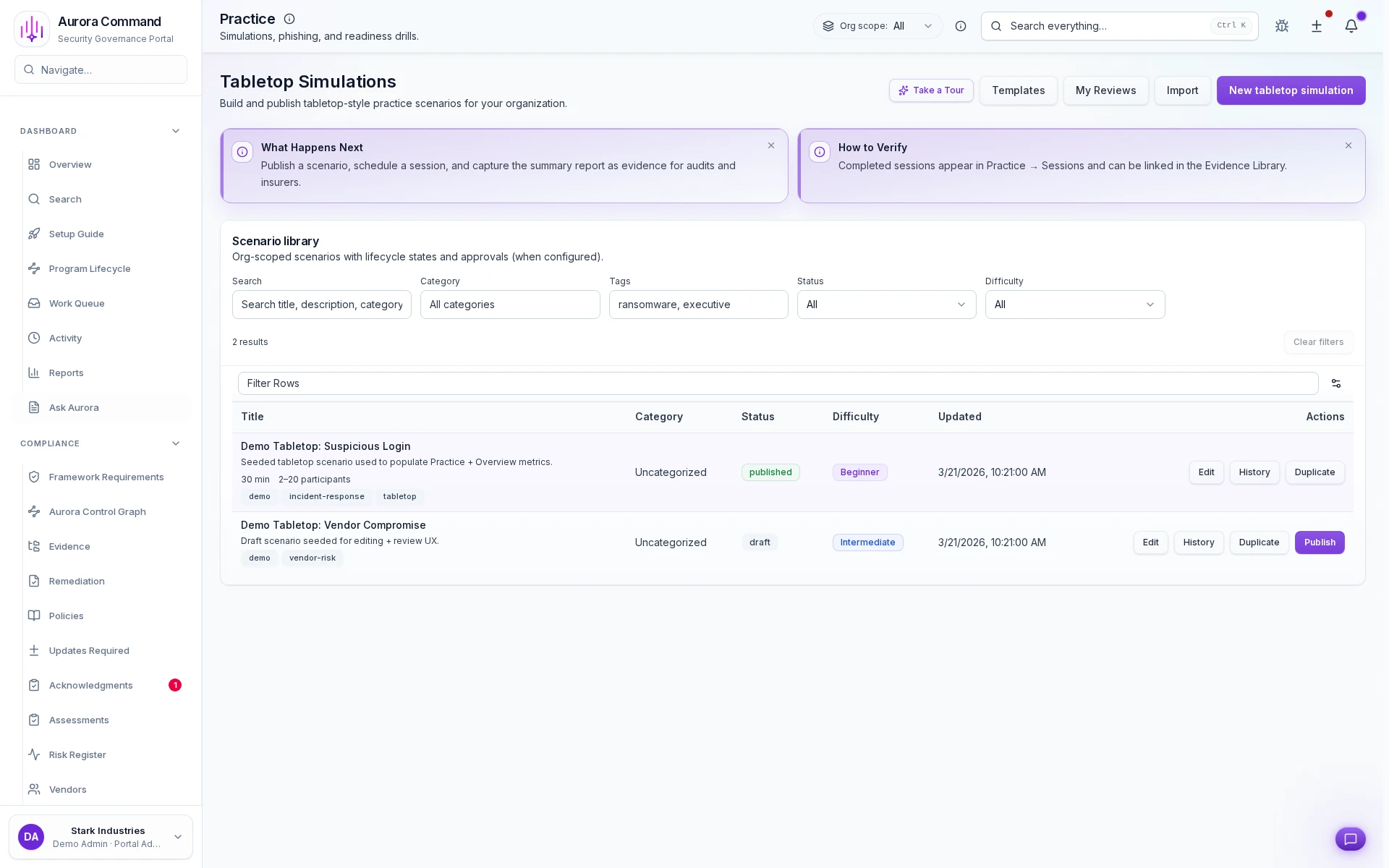
1/5
Escalation Paths With Backup Chains and Channel Rules
Define primary, secondary, and tertiary escalation paths in one versioned plan, each with channel preferences, timeout thresholds, and backup contacts that activate automatically.
Artifacts reviewers recognize, plus sample previews of structure.
Scroll for artifact previews
Fire Drills Through Your Existing Paging And Messaging Stack
Common Questions About Emergency Communication Drills
Does Aurora send the actual emergency notifications?
Does Aurora send the actual emergency notifications?
Aurora integrates with your existing paging and messaging stack: PagerDuty, Vonage, Zoom, and others. It documents the plans, fires drill notifications through those channels, and logs every acknowledgment and escalation regardless of which channel delivered it.
How do drill records satisfy audit and insurer requirements?
How do drill records satisfy audit and insurer requirements?
Drill participation logs and response-time metrics map directly to the control requirements auditors and insurers check. When a reviewer asks for proof that out-of-band communication has been tested, you export the evidence in one click rather than assembling it from email threads.
How often should we run communication drills?
How often should we run communication drills?
Most frameworks expect at least annual testing, but quarterly drills give you enough data points to spot response-time trends and fix channel gaps before they become audit findings. Aurora tracks drill cadence so you never fall behind schedule.
Can we measure response times across different channels?
Can we measure response times across different channels?
Yes. Acknowledgment metrics break down by team, channel, and drill cycle. You can compare SMS versus voice versus chat response speed, identify which channels consistently miss sub-5-minute targets, and adjust escalation rules based on real performance data.
How do you test whether escalation paths actually work?
How do you test whether escalation paths actually work?
Drills simulate real escalation conditions. If a primary contact does not acknowledge within the timeout window, the notification automatically escalates to the backup chain. The drill log captures every tier that fired, so you see exactly where the path held and where it broke.
How is this different from Incident Readiness & Response?
How is this different from Incident Readiness & Response?
Emergency Communications focuses on notification chains, communication drills, and acknowledgment timing. Incident Readiness & Response covers the broader IR lifecycle: runbooks, role assignments, tabletop exercises, and post-incident follow-ups. The two modules complement each other. Tested communication is one input into a complete IR program.
Replace Untested Plans With Drill Backed Readiness Proof
Share your current drill process and we will show how to turn it into measured response times, structured participation logs, and evidence insurers accept at renewal.
Share one drill plan or notification workflow. We will show delivery, acknowledgments, and the audit trail reviewers can verify.