Feature
Policy requirements and drift monitoring: Define policy requirements, then monitor for drift with a reviewable history.
Define measurable policy requirements and monitor for drift when reality changes. Record exceptions with ownership and decision trails, so reviewers can see what changed and why.
Define policy requirements, then monitor for drift with a reviewable history.
- Approvals stay attributable:Policy, control, and decision changes keep a visible owner and review trail.
- Controls map once:Reuse the same operating record across overlapping frameworks and reviewer asks.
- Evidence stays tied in:Governance decisions stay connected to the proof and timestamps behind them.
- Changes stay defensible:Keep the program current between audits instead of rebuilding the story from scratch.
Sample output
Requirement drift report
Governed report
Ship Policy Reviews With Approvals Attached
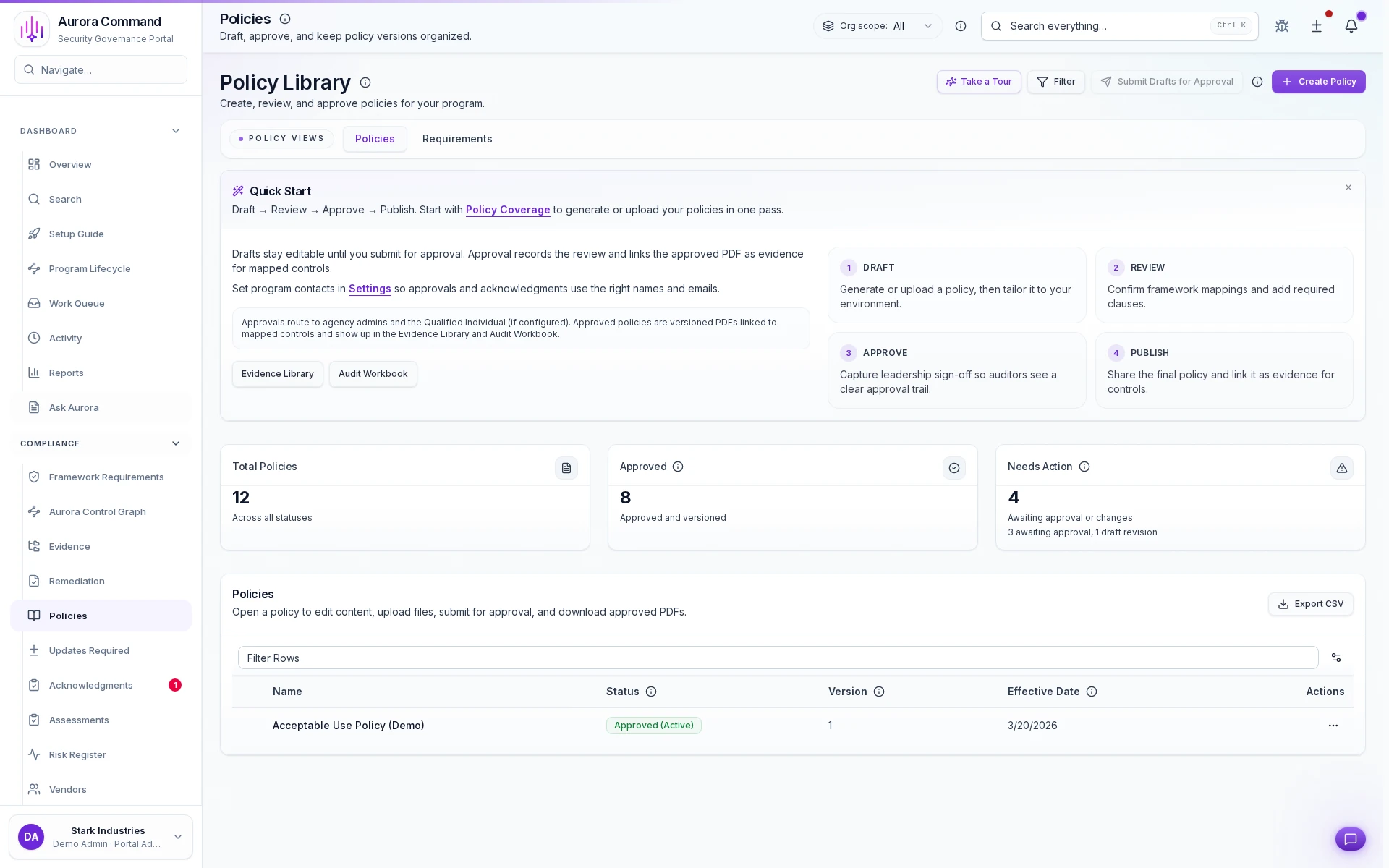
Walk every policy from draft to publish
Capture leadership sign-off as evidence
Show what still needs approval today
Pin every version to the controls it covers
How Teams Keep Policies Approved And Current
01
Start from the current policy set
Centralize the policy library so teams stop managing versions across folders and email threads.
02
Route changes to the right owners
Keep legal, security, and executive reviewers attached to the same approval path.
03
Approve and publish new versions
Preserve version history and sign-off records instead of relying on informal acknowledgments.
04
Map policies to frameworks
Reuse the same operating record across overlapping frameworks and buyer asks.
05
Export the current record on demand
Share the live version, approval history, and supporting context without scrambling for files.
What This Adds To Policy Operations
Feature 1 of 5: Designed for
1/5
Designed for
Continuous compliance • Audit preparation • Buyer security reviews
Artifacts reviewers recognize, plus sample previews of structure.
Scroll for artifact previews
Connect Policy Work To The Rest Of The Program
Questions Teams Ask
How do policies, controls, and approvals stay tied together?
How do policies, controls, and approvals stay tied together?
Aurora keeps version history, ownership, approvals, and related evidence attached so the governance record is easier to defend later.
What does the team actually share from this work?
What does the team actually share from this work?
Teams usually share Requirement drift report; Exception decision trail. The goal is to give reviewers the right package without making them reconstruct how the program operates.
Where does this help most in recurring audits?
Where does this help most in recurring audits?
It fits best when the team is handling Continuous compliance, Audit preparation, Buyer security reviews and needs the work to stay reusable instead of being rebuilt each cycle.
What changes after rollout?
What changes after rollout?
Detect drift against defined requirements Reduce untracked exceptions between review cycles
Share The Framework, Control Set, Or Policy Review You Keep Rebuilding.
We’ll show how Aurora keeps approvals, change history, and evidence connected so the next review starts from current work.
Share one request and we will show the path to requirement drift report without losing approvals, ownership, or reviewer context.